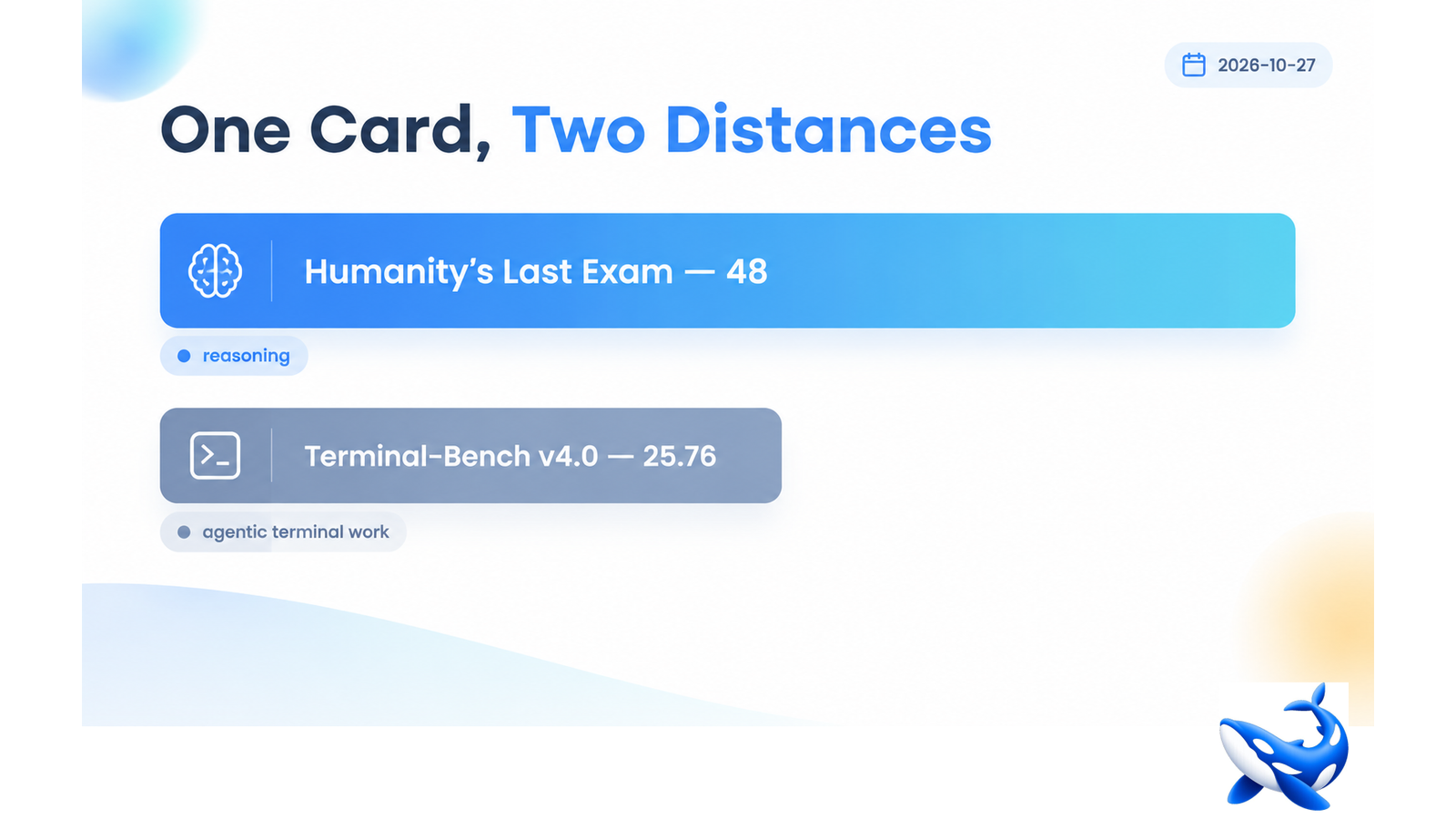

Through OrcaRouter you can read the MiniMax M3.1 Flash benchmarks alongside the models it competes with. The loudest number is 48 on Humanity’s Last Exam, up from 39 on the previous M3 and ahead of DeepSeek V4.1 Flash 1017 at 43.3 [INDEPENDENT]. The quiet number is 25.76 on Terminal-Bench v4.0, well behind the same DeepSeek card’s 33.84. Both are true, both are on the same model, and together they describe a card that reasons well and drives a terminal poorly.
That pair is the whole evaluation story, and it is the reason a single headline score is useless for buying decisions.
The independent profile
| Benchmark | M3.1 Flash | DeepSeek V4.1 Flash 1017 |
| Artificial Analysis Intelligence Index | 42.7 (84th pct) | 45.1 (86.7th pct) |
| Humanity’s Last Exam | 48 | 43.3 |
| SciCode | 53.4 | 55.9 |
| Long-Context Recall | 79.67 | 82.67 |
| Terminal-Bench v4.0 | 25.76 | 33.84 |
| DeepSWE v1.1 | 73.7 | 77 |
| OSWorld 2.0 | 61.7 | — |
| Agents’ Last Exam | 29.6 | — |
The MiniMax rows come from Artificial Analysis as reported in third-party coverage and as carried on the model page; the DeepSeek rows come from the same evaluator [INDEPENDENT]. Same lab, same harness family, so the comparison is at least internally consistent.
See also: Thomas Berkley on Building and Growing a Successful Business in Cleveland
What the 48 buys, and what it does not
Humanity’s Last Exam is a hard reasoning benchmark: expert-written questions across disciplines, designed so that a strong model scores in the forties and fifties. Forty-eight is a good score and a genuine improvement over 39.
It measures whether the model can reason its way to a correct answer when the answer is not in its training data. It says nothing about whether the model can plan a sequence of tool calls, recover from a failed command, or notice that a step did not do what it expected.
That is what Terminal-Bench measures, and 25.76 is the lowest row in this comparison by a wide margin. Four out of five terminal tasks fail, roughly speaking.
MiniMax’s own positioning for the model — long-horizon agent work, tool-driven research — sits awkwardly beside that number. It is worth saying plainly: the reasoning is there, the agency is not, at least on this harness.
The hallucination number, read carefully
Artificial Analysis also measured this card on AA-Omniscience, a benchmark for factual recall and abstention. The reported result: an overall score of 16, with a 93% hallucination rate, defined by the evaluator as the share of non-correct answers that were outright wrong rather than partial answers or refusals [INDEPENDENT].
Read the denominator before reacting. The card answered 56% of questions correctly — ahead of DeepSeek at 43% and GLM-5.3 Flash at 28% on the same benchmark. The 93% describes the character of the other 44%: almost none of them were “I don’t know”, nearly all were confident wrong answers.
For an agent, that is the more dangerous failure mode. A model that abstains can be caught by a check. A model that invents an API endpoint, a CVE identifier or a file path with full confidence gets acted on.
The practical mitigation is boring and effective: constrain the model to retrieved context, require citations to supplied material, and validate outputs against a schema or a test rather than trusting the prose.
Four gates that make the hallucination number survivable
A model that invents confidently is usable if the pipeline can catch inventions. Four checks do most of the work, in increasing cost.
Schema validation. If the output is JSON, validate it against a schema before anything downstream reads it. This catches malformed structure and missing fields, and it catches some fabrication because invented field values frequently break types.
Citation requirement. Ask the model to attach the source span for every factual claim — file and line, document and page, log timestamp. Claims without a citation are flagged for review. This is the highest-value single change, because an invented citation is visible in a way an invented sentence is not.
Referential checks. Any identifier the model produces — a CVE, a function name, a hostname, an endpoint — should be looked up in the supplied material. A cheap exact-match against the input catches a large share of invented specifics.
A second opinion on the risky claims only. Re-ask the model about a sample of its own factual claims with the source text in context and compare. Expensive per call, cheap per claim if you sample.
Each gate adds engineering. Together they convert “we cannot trust this model’s facts” into “we can trust the parts that pass the gates”, which is how any model with a nonzero error rate gets used in production.
The alternative — using a model with better factual recall and worse reasoning — trades one failure for another. The gates are the way to keep the reasoning and bound the risk.
Where the vendor’s own claims sit
MiniMax reports 62.2 on Automation-Bench v1.0.6 against DeepSeek V4.1 Flash 1017’s 60.5, and 76.2 on BankerToolBench, tying Claude Opus 5 [VENDOR]. Those are vendor-run evaluations on benchmarks the vendor selected, and they point the opposite way from Terminal-Bench.
Both can be true. A business-workflow benchmark rewards producing a plausible, structured, useful answer — which the M3.1 profile is good at. A terminal benchmark rewards acting correctly in an environment — which it is not.
When vendor rows and independent rows disagree, the independent row usually tells you about the failure you will experience in production, because it was run on a harness the vendor did not design.
Cost per answer, not cost per token
The same independent evaluation puts the cost per Intelligence Index task at $0.22, down from about $0.51 on M3 [INDEPENDENT]. That halving is the real story of the release: same price list, roughly half the tokens burned per solved task.
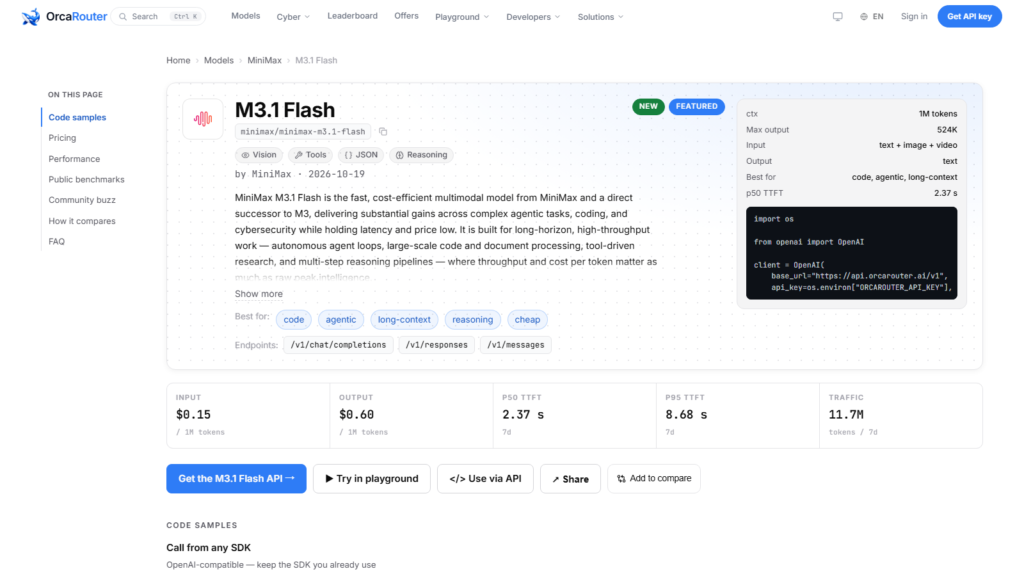
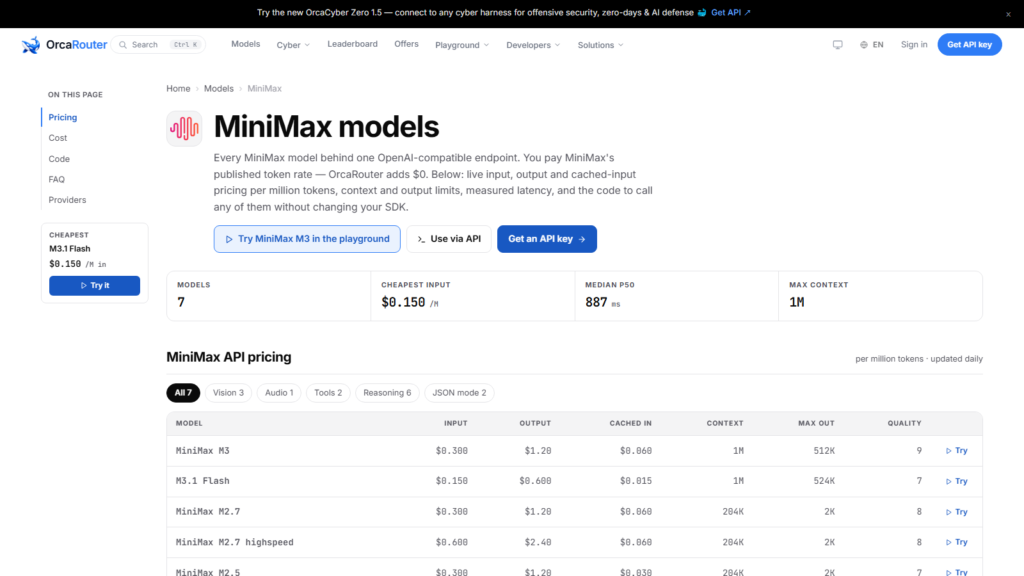
On our own gateway, the card is priced at $0.15 in and $0.60 out with cache at $0.015, and it ran at 94.0 tokens per second with a 1,735 ms median first token over the seven days ending 2026-10-26 [OURS]. Traffic was small — 3,139,844 tokens — so treat the serving figures as early.
The reading that actually helps a buyer
Three sentences, in order of importance.
Reasoning: yes. 48 on HLE and 42.7 on the index put it in the upper fifth of models, and the improvement over M3 is real.
Agency: not yet. 25.76 on Terminal-Bench v4.0 means an autonomous loop that depends on tool reliability will struggle, whatever the vendor’s positioning says.
Factual recall: use retrieval. 56% correct with a 93% wrong-when-wrong profile means the model should be grounded, not trusted from memory.
That combination fits a specific product: a reasoning-heavy assistant that proposes answers and structures, with a human or a validator in the loop. It fits badly an unattended agent that runs commands overnight.
The takeaway
Forty-eight on Humanity’s Last Exam is a real result and the headline MiniMax will lead with. Twenty-five point seven six on Terminal-Bench v4.0 is the row that predicts how it behaves when you give it a shell.
Buy it for reasoning with a validator in the loop, for long structured outputs, and for the halved cost per solved task. Do not buy it as an autonomous agent and do not let it answer factual questions ungrounded.
Sourcing note: intelligence index, Humanity’s Last Exam, SciCode, long-context recall, Terminal-Bench v4.0, DeepSWE v1.1, OSWorld, Agents’ Last Exam and AA-Omniscience figures are Artificial Analysis’s published results, as carried on the model page and in third-party reporting [INDEPENDENT]. Automation-Bench and BankerToolBench rows are MiniMax’s own claims [VENDOR]. Pricing, latency and throughput are OrcaRouter catalogue data and production telemetry for the seven days ending 2026-10-26 [OURS].