ByJohn A
Monsoon, Salt Air and Plant Dust: Specifying Pneumatic Fittings in India
A fitting that performs well in a climate-controlled German test lab tells you very little about how it will behave in Kandla during August. Indian plants put components through conditions that most catalog data never accounts for. Humidity swings from forty percent to near saturation within weeks. Coastal installations sit in chloride-laden air year-round. Cement, sugar, and mining sites run in constant particulate. Specifying pneumatic fittings in India means reading the site before reading the spec sheet, and that order matters more than most purchase decisions allow for.
What makes this awkward is that failures here are slow. Nothing dramatic happens on day one. Corrosion creeps, seals stiffen, dust packs into release collets, and eight months later a line that ran perfectly starts dropping pressure at random. By then, nobody connects the fault to the original purchase order. Teams buying pneumatic fittings in India often end up paying twice, once for the cheap part and again for the shutdown it eventually causes.
Humidity and Condensate Damage in Compressed Air Lines
Compressed air carries water. That is unavoidable physics: compressing ambient air concentrates whatever moisture it holds. During monsoon, when ambient relative humidity stays above eighty percent for weeks, the condensate volume reaching your distribution lines climbs sharply.
That water does three things inside a fitting.
- It sits in low points and attacks any carbon steel component from the inside.
- It washes lubricant off seal faces, so O-rings run dry and then tear.
- It carries dissolved contaminants that leave deposits on sealing surfaces.
Drying equipment handles most of this, though dryers are sized for design conditions and monsoon rarely matches design conditions. The more honest position is that some moisture will reach your fittings no matter what you install upstream. Specify parts that tolerate it rather than parts that assume it will never arrive.
Chloride Corrosion and Stainless Steel Grade Selection
Coastal sites change the material conversation completely. Airborne chloride attacks stainless steel through pitting, a localized failure that starts as a pinhole and works inward. Surface inspection often shows nothing until the wall is already compromised.
Grade 304 stainless resists general corrosion well and resists chloride pitting poorly. Grade 316 contains molybdenum, which greatly improves pitting resistance. On a Chennai, Kochi, Mumbai, or Gujarat coastal installation, that difference decides service life.
If your site sits within a few kilometers of the sea, or downwind of a chemical plant releasing chlorides, 316 is the sensible default for exposed fittings. Inland dry-climate sites can often run 304. During a Bathroom Renovation, choosing corrosion-resistant fittings is especially important in humid or coastal environments. Brass fittings in marine air corrode visibly within a season, which at least gives you warning, though by then the thread has usually lost its seal.
Particulate Ingress in Push-In and Quick Connect Fittings
Dust behaves differently from moisture. It does not corrode; it jams.
Push-in fittings hold tube using a gripping collet with small hardened teeth, released by pressing a collar. Fine particulate works into that mechanism. The collet stops releasing cleanly, the tube stops seating fully, and the joint develops a slow leak nobody can locate because it looks correctly assembled.
Quick connect couplings face the same issue at the sleeve. Cement plants and grinding operations see this constantly.
Some site habits that help:
- Cap unused ports rather than leaving them open to the plant atmosphere
- Position fittings away from direct discharge paths where possible
- Blow down tube ends before insertion, since dust on the tube surface gets carried inside.
- Check collet release action during routine maintenance rather than waiting for leaks.
Stainless steel bodies handle abrasive environments better than polymer ones, mostly because the external surfaces survive repeated cleaning.
Thermal Cycling and Seal Performance in Indian Plants
Rajasthan summer shop floors reach temperatures that soften standard nitrile seals. Winter nights in the north drop enough to stiffen them. Repeated cycling between those states makes elastomers take a permanent set, and a set seal no longer springs back against its sealing face.
Ask your supplier about seal material and temperature range, not only body material. That question gets skipped far more often than it should.
Metal-to-metal sealing arrangements avoid the problem entirely where the application allows. Needle valves and pipe fittings that seal on machined surfaces have no elastomer to degrade. They cost more and take longer to assemble, and for outdoor runs or high-temperature zones they usually pay for themselves.
Matching Fitting Specification to Site Conditions
Here is a rough way to approach the decision before you raise a requisition.
- Coastal or chemical exposure, choose 316 stainless throughout
- High particulate, favor metal bodies and protect release mechanisms.
- Wide temperature swing: check seal compound rating or move to metal sealing.
- Washdown areas in food and pharmaceutical plants, stainless with smooth external surfaces
- General inland dry plant, standard stainless or brass depending on budget
None of this replaces a proper site survey. It stops the most common mistake: ordering a standard catalog part for a site that is anything but standard.
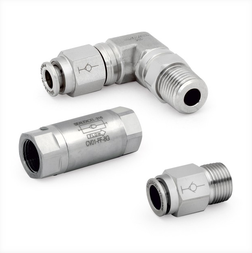
Sealexcel manufactures stainless steel push-in fittings, push-on fittings, precision pipe fittings, flow control regulators, quick exhaust valves, pneumatic check valves, quick connect couplings, needle valves and 2/3 way ball valves at its facilities in India, with in-house testing including helium leak detection.